
In this edition of repsychl’s ‘You Should Know About’ series, we introduce French outsider artist Marcel Storr.
Born in Paris, Storr endured a difficult childhood after being abandoned at the age of two. Later, he was sent to Alsace to be cared for by nuns. Drawings of churches were his first artistic endeavor by 1932, but it was a personal, secretive one.

His artwork developed in several phases. Until the early 1960s, his church paintings were characterised by attention to detail and a sense of realism. The size of Storr’s drawings increased in the late 1960s when he began depicting fantasy structures of imposing scale and character, including palatial cathedrals resembling religious architecture icons like the Sacré Coeur in Paris or Hagia Sophia in Istanbul. Storr first worked in pencil, and then filled in his drawings with ink.
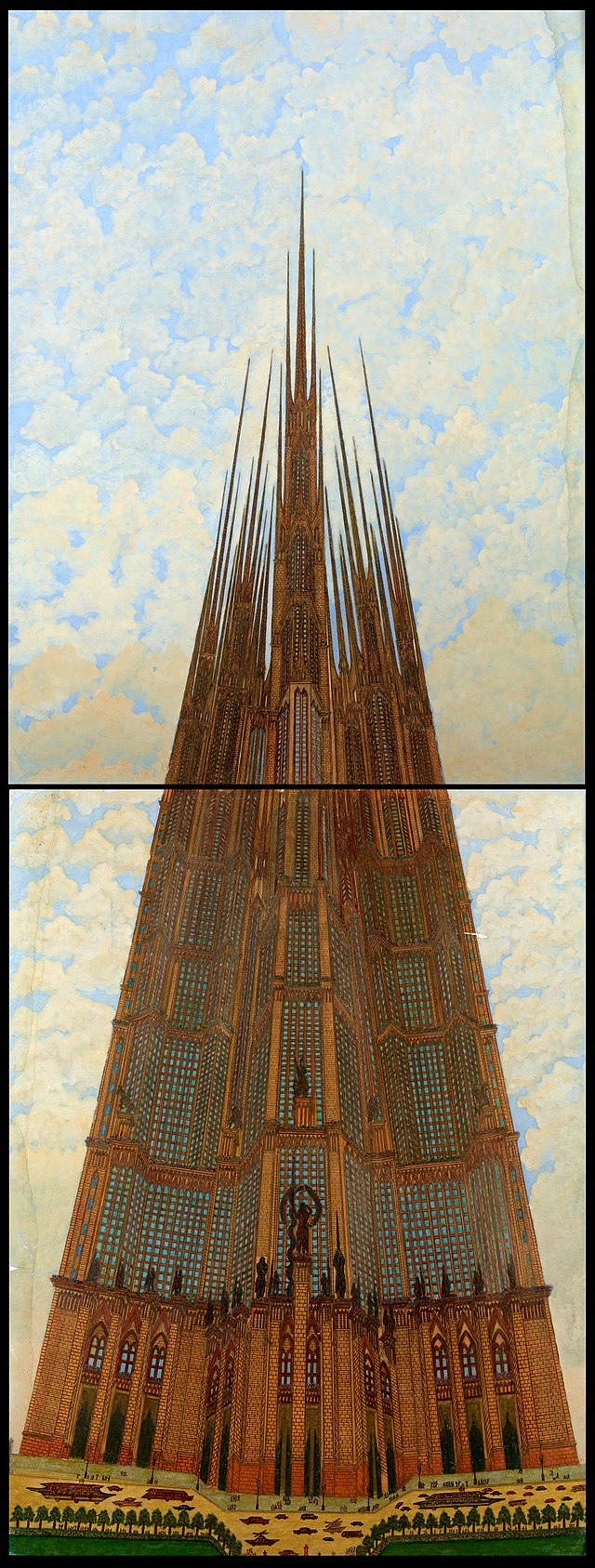
Known as “The Megalopolises,” his final series of works depicts dizzying clusters of towering ziggurats, many connected by buttress-bridges, along with dreamlike cityscapes.
In the event of a nuclear attack, Storr believed the President of the United States would need his drawings to rebuild Paris.
A number of Storr’s creations are deeply rooted in other art forms, including allusions to Angkor Wat temples in Cambodia, future cities depicted in sci-fi films and cartoons, and the elaborate, richly textured “Ideal Palace,” an outdoor sculpture built by Ferdinand Cheval.

Bertrand and Liliane Kempf discovered Storr’s work in 1971. After Storr’s death, the Kempfs acquired all 63 of his known pictures. For the first time ever, some of the works were exhibited in 2001 at Halle Saint-Pierre in Paris. As a result, Laurent Danchin organised a solo exhibition in 2011 at the Pavillon Carré de Baudouin. A large selection of Storr’s drawings was exhibited at the Hayward Gallery in London during the summer of 2013 as part of their exhibition, “The Alternative Guide to the Universe.”


